
In the late 2000s, poker lovers, whether they played Texas Hold’em or Omaha, spent hours on the Full Tilt Poker platform. Anyone who played on the platform back then probably feels some kind of emotion when they remember it today. I know I do.
It was a platform where thousands of players were online at any given moment. Full Tilt Poker was also known for its famous names, including Phil Ivey, Tom Dwan, and Viktor Blom. These players were playing for thousands of dollars in a single hand, making the platform even more exciting to watch.
Unfortunately, today, when you type Full Tilt Poker into Google, you will mostly find old videos, pictures, and a few other things. What remains of Full Tilt Poker today is mostly history.
In this blog, we will talk about the rise and fall of Full Tilt Poker and go into detail about how the collapse of this once-great poker giant happened.
Image generated by AI
The Birth of Full Tilt Poker!
Back in 2004, when the online poker scene was already popular and had its own established player base, Full Tilt Poker entered the scene. From the very beginning, it brought a certain energy of its own.
It was founded by some of the best-known poker players of that time, including Chris Ferguson, Howard Lederer, and Mike Matusow, who became recognizable faces of the Full Tilt brand.
The platform did not only attract new and amateur players, but also professional poker players. Those professionals who were present on the platform helped increase its popularity, because for the first time, regular players could sit at the same tables as the pros.
Being able to test their skills against big names and professional players from the world of poker, while also chatting with them, helped make Full Tilt Poker even more popular.
The Moment Full Tilt Poker Got Even More Attention!
Image generated by AI
The real madness began when younger professional players joined the platform, including Phil Ivey, Tom Dwan, Gus Hansen, and Viktor Blom. From that moment on, there were games that thousands of people watched and followed.
Some players would even log onto the platform just to watch the professionals battle it out. Their in-game nicknames became famous and were quickly recognized by poker fans.
However, Full Tilt Poker had another great idea that would take things even further, and it came in 2010.
The platform exploded in popularity!!

Image generated by AI
Rush Poker was introduced on the Full Tilt Poker platform in 2010. Rush Poker dramatically sped up the game, making it a great option for players who did not want to waste time waiting after folding a hand.
The way it worked was simple. As soon as a player folded their hand, the platform would automatically move them to a random new table and deal them a new hand. Of course, they would also be playing against a completely new group of players.
In my opinion, this had both advantages and disadvantages.
Advantages!
Players did not have to wait for a hand to finish, especially if they were dealt bad cards such as 7 and 2. They could simply keep folding, and each time they did, they would automatically move to another table with a completely new hand. Did not even have to wait to fold their cards. They had the option of using Quick Fold, which would automatically move them to another table as soon as they used it.
They could repeat this process as many times as they wanted until they received a hand they actually wanted to play.
For players who preferred a fast-paced game, this was ideal. That is why the creation of the Rush Poker format brought even more popularity to Full Tilt Poker.
Disadvantages!
One of the main problems was that every time you folded your hand, you were moved to a different table. This meant you were constantly facing new players, and you had no idea what kind of playing style they had.
Were they aggressive? Did they like to bluff? How willing were they to take risks? These were all things you had to figure out while playing.
Another major disadvantage was that players would often play only when they had strong hands. This meant that if you were dealt good cards and decided to enter a battle, there was a good chance that the player who stayed in the hand also had a strong hand.
My Opinion on the Rush Poker Format:
I tried this type of game as well, but generally, I was not a big fan of it. I preferred standard cash games and tournaments.
I enjoyed watching and studying the playing styles of other players. I had the patience to wait, even when I was dealt bad cards ten times in a row.
After all, poker is a game of patience.
The Downfall and Collapse! ( Black Friday)
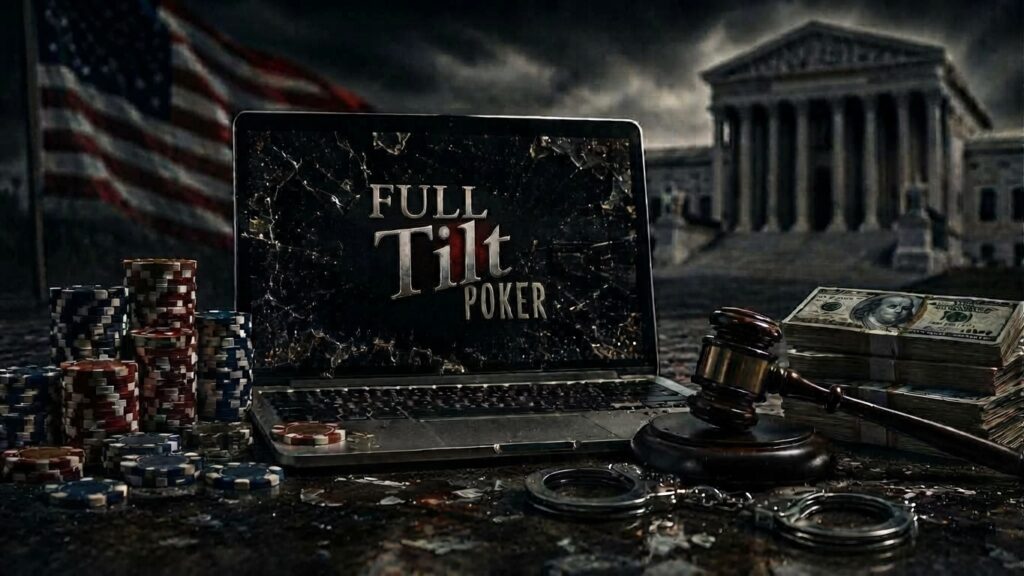
Image generated by AI
Full Tilt Poker was at the very top of the online poker world, with millions of people playing poker on the platform. Looking at its position at the time, it seemed almost impossible that the company could ever collapse or shut down. However, everything quickly started to go wrong.
April 15, 2011, was by far the darkest day in Full Tilt Poker’s history. It became known as Black Friday.
On that day, the United States Department of Justice brought charges against the founders and operators of several leading online poker sites, including PokerStars, Absolute Poker, and, of course, Full Tilt Poker. They were accused of bank fraud, money laundering, and violations of laws prohibiting illegal gambling over the internet.
The domains were seized, and the poker sites became unavailable to players almost overnight, especially to players from the United States, who made up a large part of the player base.
However, that was not the end of the story. After this event, another major shock followed.
Full Tilt Poker had a huge hole in its finances. The money belonging to players, which was being held in their accounts on the platform, had been used to cover operating expenses and pay millions of dollars in profits to the owners and management.
That money was supposed to be kept in separate and secure accounts, but this failure had a devastating impact on the company. Once the accounts were frozen, there was not enough money available to pay the players.
The brand lost the trust of its players almost instantly. Thousands of players were left confused and worried, wondering whether they would ever be able to get their money back.
Personally, I did not have any problems because by the time this happened, I had already switched to PokerStars. Because of that, I was not affected by what happened to Full Tilt Poker.
Rising from the Ashes: PokerStars and the Repayment of Players!
Image generated by AI
After the Black Friday event I wrote about above, it looked like Full Tilt Poker was definitely dead. Players waited for months to get their money back, hoping for some kind of repayment, while trust in online poker platforms had dropped dramatically.
However, not long after that, help arrived in 2012 from Full Tilt Poker’s biggest competitor at the time PokerStars.
PokerStars was far more successful and managed to reach an agreement with the U.S. authorities, allowing the company to acquire the assets of the collapsed Full Tilt Poker. Of course, the main condition and priority of the deal was to fulfill all obligations to the affected players and return their frozen funds.
PokerStars did exactly that. They repaid millions of dollars to players around the world, helping to restore at least some of the lost trust in online poker platforms.
What is even more interesting is that shortly afterward, PokerStars tried to restore trust in the Full Tilt Poker brand by bringing the software and platform back online. They even made some visual changes to the platform.
However, despite all the efforts to bring back the glory of Full Tilt Poker, they simply could not recreate what had once made the platform special.
It was no longer the same platform. The player base had dropped dramatically, the competition had become much stronger, and Full Tilt started to look more like a brother or sister brand of PokerStars.
It no longer had the status of a giant and independent poker company that it once had.
The Final Chapter, going Down in History (2021)
Image generated by AI
For years, Full Tilt Poker remained in operation, trying to survive in the shadow of PokerStars. It simply became clear that the platform could not survive and was losing its battle with time.
Everything around it was evolving and becoming more modern, while Full Tilt Poker, which had once been a synonym for online poker, had gradually become unnecessary.
The final blow came in February 2021. At that time, Flutter Entertainment, the parent company that owned both PokerStars and Full Tilt, made the decision to completely shut down Full Tilt Poker.
The software was shut down, as were all of its servers, and the remaining accounts and users were transferred to the PokerStars network.
Of course, the memories remained. Full Tilt Poker left a lasting mark on an era when it was at the very peak of its popularity, and for many poker players, it will always be remembered as one of the platforms that helped define online poker.
Recommended Blogs!
Note!
The original images and logos of Full Tilt Poker and PokerStars were not used in this blog due to copyright restrictions.